

On-Chain Programs
All protocol logic is deployed to Solana mainnet. These are the canonical program addresses:Bonding Curve Pricing
Share prices are determined by a linear bonding curve that maintains constant-sum invariants. For a binary market with outcomes ( A ) and ( B ): Where ( S_A ) and ( S_B ) represent the total supply of each outcome’s shares. This ensures: The cost to purchase ( \Delta ) shares of outcome ( A ) is computed as: This integral yields continuous liquidity at prices that reflect aggregate market belief.AI Resolution System
Orica employs a sophisticated AI system to validate market creation requests and resolve outcomes after markets close.How AI Resolution Works
How AI Resolution Works
The resolution pipeline operates as follows:
- Market Validation: When a market is submitted, the AI evaluates whether the question is resolvable, unambiguous, and has a definite close time.
- Deep Research: At resolution time, the system uses Firecrawl to scrape and analyze relevant web sources, news articles, and official data feeds.
- LLM Analysis: Claude 4.5 Sonnet (via OpenRouter) processes the research data and determines the correct outcome based on the market’s resolution criteria.
- On-Chain Submission: The resolved outcome is submitted to the blockchain, triggering the dispute window.
Claude 4.5 Sonnet
Primary reasoning model for market validation and outcome determination.
OpenRouter
API gateway providing reliable access to frontier AI models.
Firecrawl
Web scraping infrastructure for deep research and data gathering.
Core Features
On-Chain Settlement
All trades, positions, and payouts execute via smart contracts on Solana. Funds are held in program-controlled vaults with deterministic redemption logic.
Continuous Liquidity
The bonding curve AMM ensures you can always enter or exit a position at a fair price derived from current supply distribution.
AI-Powered Resolution
Markets are resolved by Claude 4.5 Sonnet with deep research capabilities, ensuring accurate and well-reasoned outcome determination.
Decentralized Disputes
If an AI resolution is contested, a weighted voting system allows stakeholders to dispute and correct erroneous outcomes.
Market Lifecycle
1
Market Creation
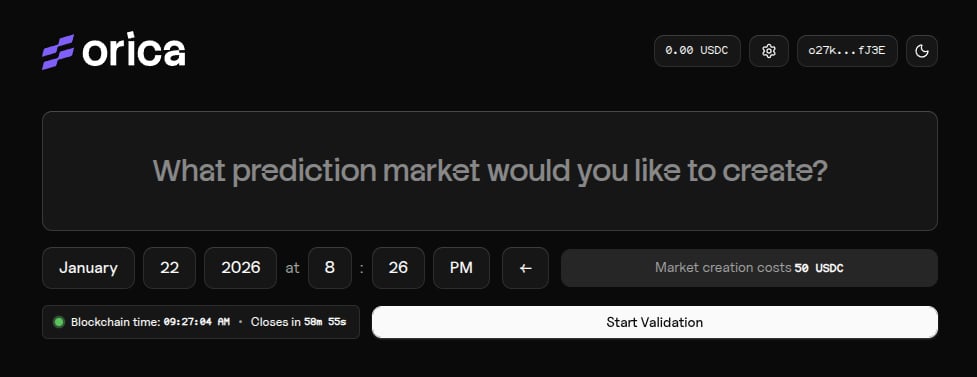
A market is submitted with a question, possible outcomes, and close time. The AI validates the market for resolvability and clarity. Metadata (description, resolution criteria, image) is stored on IPFS.
2
Trading
Users buy shares of an outcome they believe will occur. Share prices follow the bonding curve formula, adjusting in real-time based on supply.
3
AI Resolution
After the close time, Claude 4.5 Sonnet analyzes the market using Firecrawl-powered research and submits the resolved outcome on-chain.
4
Dispute Window
Stakeholders can challenge the AI resolution within the dispute period. Disputes trigger weighted voting among token holders.
5
Redemption
Holders of the winning outcome’s shares redeem them 1:1 for USDC from the market vault. Losing shares become worthless.
Integration Options
Orica provides multiple integration paths depending on your use case.- Public API
- TypeScript SDK
- Direct RPC
The Public API is a read-only REST and WebSocket service that provides:
- Market listings, metadata, and status
- Trade history and analytics
- Dispute state and voting records
- Real-time price and activity feeds
Next Steps
Quickstart
Get up and running with the API and SDK in minutes.
Core Concepts
Understand markets, trading mechanics, and resolution.
API Reference
Explore REST and WebSocket endpoints.
SDK Reference
Build transactions and interact with on-chain state.